
A war without heroes
The Iran war is in the hands of some of the world’s worst leaders, so how can anyone expect a good outcome?

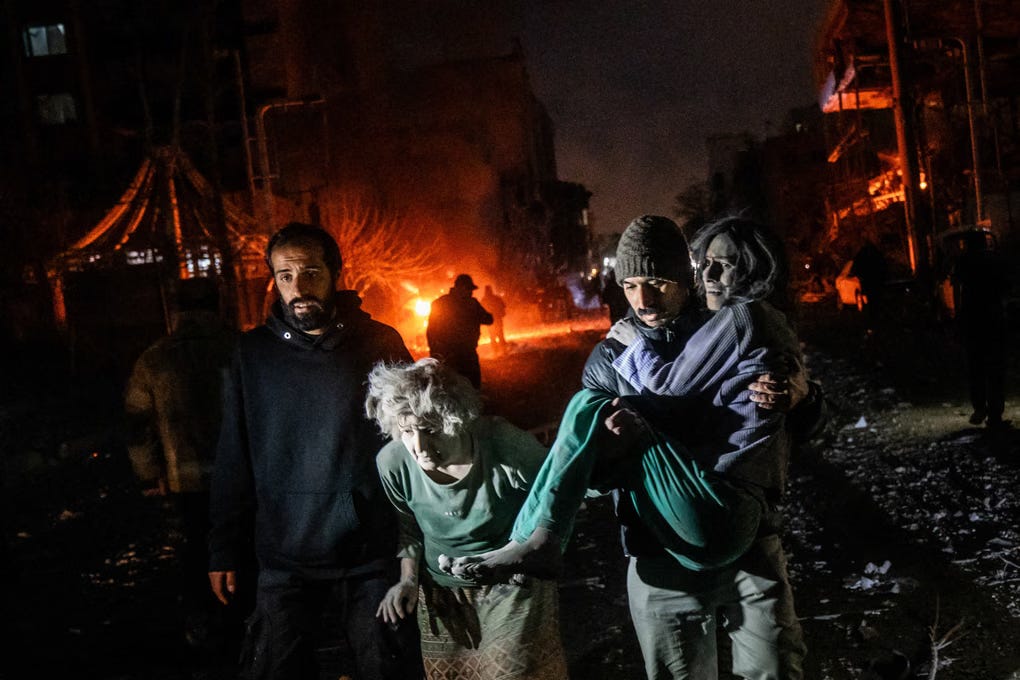
Civilians in Teheran - ‘mere’ collateral damage
Who are the good guys in this war with Iran? (this is not a gender oversight – most wars, with significant exceptions, (Cleopatra comes to mind) are led by men.
What if there are no good guys, only least worst guys? These questions matter because all wars end and it also matters how they end and who emerges from the rubble.
So, let’s run through the list of main players:
Iran is governed by a theocratic regime that has no compunction over killing its own people, has a long history of repression and an appalling record of discriminating against its female citizens, minorities and, basically anyone who dares challenge the government.
Unlike Iran, the America and Israel have democratic governments, despite the best efforts of Messers Netanyahu and Trump to undermine the pillars that underpin rule of law and accountability. Because they are both ego maniacs, their main priority is self-preservation. All other considerations are secondary.
Israel, however, has a clear, albeit unobtainable, objective, which is to ensure that Iran can never pose a threat to its survival. The Trump administration’s’ objectives change by the day but sure as hell have nothing to do with freeing the Iranian people from the yoke of oppression, something no longer mentioned since the shooting began.
It may be imaged that something will better will replace Iran’s repressive regime but there are reasons to have misgivings on this front.
The Israelis are in no doubt that they would like to see the restoration of the monarchy under Reza Pahlavi, the son of the late Shah Mohammad Reza Pahlavi, known, not unfairly, to readers of the Private Eye magazine as The Shit of Iran. He ran an appalling kleptocratic regime where his opponents were jailed, tortured and murdered. The suggestion is made that Pahlavi Junior will somehow be better, although he is markedly silent on his father’s crimes.
The Americans are not committed to the Pahlavi dynasty and indeed might be open to a deal with the more compliant members of the Islamic Republic’s leadership. What this means for the Iranian people is anyone’s guess. But it is highly improbable that America’s pet Ayatollahs would bring about a happy state of affairs.
Other alternatives might be better but, as of now, they are not visible to the naked eye.
Then there are the external allies of the Islamic Republic, principally Hezbollah in Lebanon and the Houthis in Yemen. Hezbollah has done its very best to destroy Lebanon, once a flourishing cosmopolitan state which was the envy of the region. The Houthis operate in a far less prosperous environment and have done their very worst to seize upon Yemen’s poverty and deepen it. No one accuses either of these death cult messianics of having a scintilla of interest in democracy or indeed an ounce of tolerance for opposition.
The war is spreading fast, embracing all the Gulf nations, not one of which enjoys democracy or liberty but, thanks to oil and gas, have thrived economically. They are governed by authoritarian hereditary sultanates. For now most of their citizens are content to trade economic prosperity for a lack of freedom but the cracks are showing. This war however is likely to put a damper on change.
It is therefore fair to say that all sides in this war are characterised by leadership which is distinctly good guy-challenged, so why can anyone expect an outcome that secures freedom for the long suffering people of the region?
If history is any guide the collapse of repressive regimes mainly leads to chaos and to even worse government. This is not axiomatic, the defeat of fascism in Germany eventually produced a flourishing democracy and the end of Soviet rule in Eastern Europe had similarly positive results.
Lamentably this happy state of affairs has not been witnessed in the Middle East where the fall of Saddam Hussein in Iraq, of Muammar Gaddafi in Libya and the Assad regime in Syria has not brought forward anything resembling an era of prosperity and freedom, although the jury is still out on Syria.
Also worrying is that the two biggest dictatorships on the planet, China and Russia, are poised to be the beneficiaries of this war precisely because they are not directly involved but stand to gain from their non-involvement. Worse still the focus on Iran may embolden the Putin regime to step up its terrifying attacks on Ukrainian civilians, while the ever hawkish Xi Jinping may feel emboldened to launch his own invasion of Taiwan.
It is probably too early to think about what will happen in the aftermath of the Iran war but the most depressing likelihood is that the greatest suffering will be inflicted on the people who neither started the war, pursued the war or even wanted it to happen. In other words the people of the region; many thousands of whom will be slaughtered. Those further away may escape the carnage but are likely to experience the kind of economic misery which hits the poor hardest.
Spot on Stephen.